
Summit County Arrest Records and Charges
Summit County arrest records are law-enforcement records tied to an arrest, booking, incident report, traffic report, citation, DUI report, or booking photo. They are requested from the Summit County Sheriff's Office Records Section when the sheriff is the custodian. Those records are not the same as the court charge record, which begins when the District Attorney or other prosecutor files a complaint, information, indictment, ticket, or other charging document with the court.
The arrest side can answer who made the arrest, whether a booking photo or incident report is releasable, and whether the person was processed through the Summit County Detention Facility. The charge side answers what the prosecutor filed, what level or code was used, whether a charge was amended or dismissed, and how it appears in the court case. Custody and roster questions belong with jail channels, while the full case file and sentence belong with Summit County criminal court records.
The image below comes from the Summit County Sheriff's Records Section report request page.
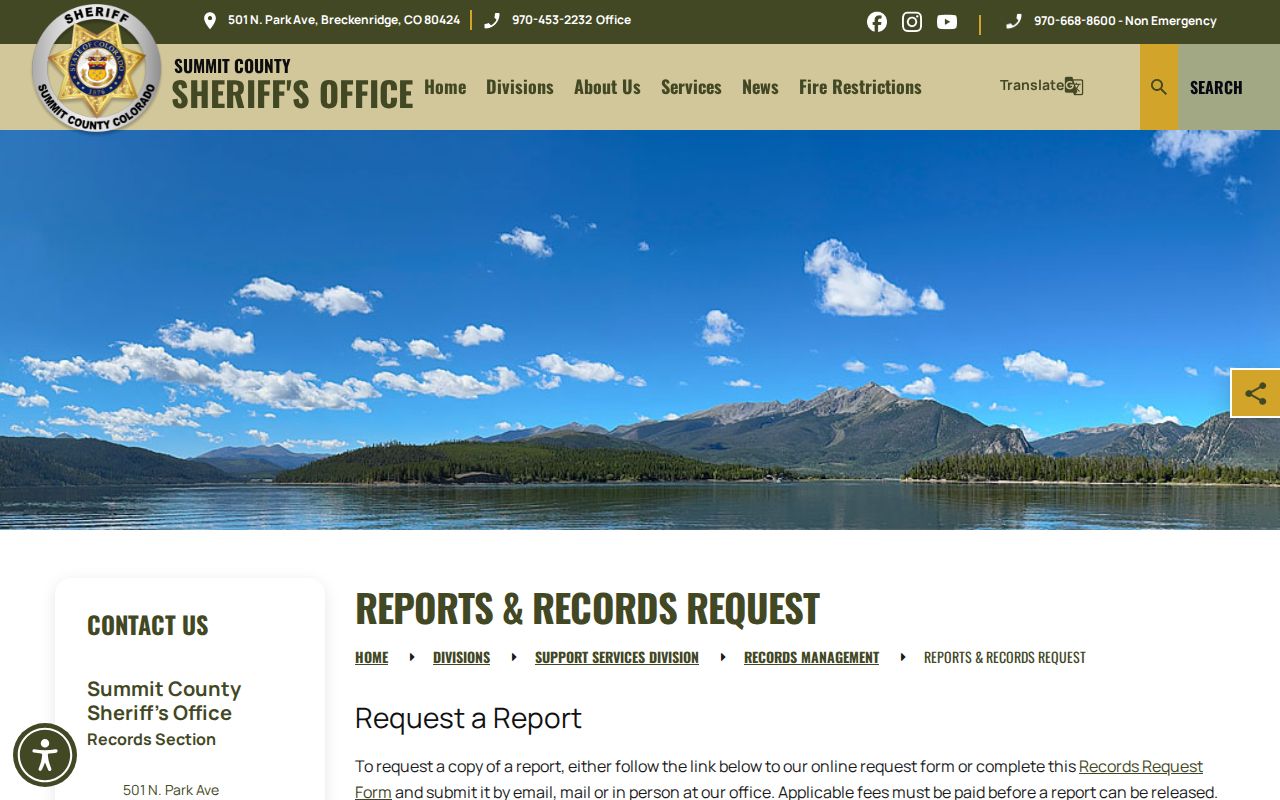
The sheriff records page is the core local source for releasable criminal reports, booking photos, traffic reports, accident reports, and DUI reports.
Find Summit County Arrest Records
The access path depends on the record type. Sheriff records are requested from the Records Section at 501 N. Park Ave., P.O. Box 210, Breckenridge, CO 80424, phone 970-453-3520, fax 970-423-8894, or Records@SummitCountyCO.gov. The office lists Monday through Friday hours of 8:00 a.m. to 4:30 p.m. Request channels include the online request form, a PDF records request form by email, mail, or in person, and payment before release when fees apply.
- Identify whether the record is a sheriff report, booking photo, traffic report, citation, accident report, DUI report, court charge, or statewide history.
- Use the Sheriff's Records Section for sheriff-held reports and booking photos.
- If an arrest was made, check whether the District Attorney has the report or whether the sheriff refers the request to the court.
- Use the court docket or record request process for the complaint, information, disposition, sentence order, ticket, or ROA.
- Use CBI Records Check only when the goal is a statewide criminal history arrest record.
A second manifest image shows the same official Sheriff records request resource as referenced in the research screenshot list.
That page is important because Colorado criminal justice record release can be delayed or redacted when an investigation is ongoing, restricted, or legally protected.
Charges After Arrest in Summit County
After an arrest, law enforcement may refer the incident to the District Attorney. The DA then decides what charges, if any, are filed. In Summit County, the 5th Judicial District Attorney serves Clear Creek, Eagle, Lake, and Summit counties. The sheriff records page says if an arrest was made in connection with an incident, requesters may need District Attorney reports at 504 Airport Road, District Attorney's Annex, Breckenridge, CO 80424, phone 970-453-3520, and may also be referred to the courts.
The local DA listing shown below comes from the Summit County Fifth Judicial District Attorney listing.
The DA role matters because an arrest alone does not prove what charges were filed, whether they changed, or whether the court accepted a final disposition.
| Office | Role in Arrest-to-Charge Path | Local Access Point |
|---|---|---|
| Sheriff's Office | Maintains releasable reports, booking photos, traffic reports, and DUI reports. | Records Section, 501 N. Park Ave., Breckenridge. |
| District Attorney | Reviews referred arrest reports and files formal charges when prosecution proceeds. | 504 Airport Road, District Attorney's Annex, Breckenridge. |
| Summit Combined Courts | Maintains the complaint, information, ticket, ROA, disposition, and sentence order. | 501 N. Park Avenue, Breckenridge. |
| CBI | Provides statewide criminal history arrest record checks. | CBI Records Check portal. |
Summit County Court Charging Documents
The court charge record is built from the formal accusation. Colorado court request categories for criminal matters include Complaint/Information, Disposition/Sentence Order, Protection Order, Ticket, and Register of Action. A complaint or information is a charging document. An indictment is less common but can be used when a grand jury charges a case. The name of the document matters because it tells the clerk what to search and what to copy.
| Complaint | Information | Indictment | |
|---|---|---|---|
| Filed By | Law enforcement or prosecutor, depending on case type. | Prosecutor. | Grand jury. |
| Common Use | Misdemeanor, traffic, or initial charging contexts. | Many felony and prosecutor-filed cases. | Serious or grand-jury-reviewed cases. |
| What It Shows | Initial accusation and cited offense. | Formal prosecutor charge list. | Grand jury accusation returned to court. |
| Where to Request | Summit Combined Courts if filed in court. | Summit Combined Courts if filed in court. | Summit Combined Courts if public and not sealed. |
Summit County Charge Status
Charges can change after the first filing. One arrest may lead to several separate charges, and each charge can have its own status. A charge may remain pending, be amended, be reduced, be dismissed, or end in a conviction. A court records user should read the charge line with the disposition and sentence fields, not just the original accusation.
| Status | What It Means |
|---|---|
| Pending | The charge has been filed but has not reached a final outcome. |
| Amended | The prosecutor or court record changed the charge language, count, or citation. |
| Reduced | The charge was lowered to a less serious offense, often through plea or case resolution. |
| Dismissed | The charge was terminated without a conviction on that charge. |
| Disposition Entered | The court recorded an outcome such as conviction, dismissal, acquittal, or other final result. |
Summit County Charges vs Convictions
A charge is not a conviction. Arrest records may show the incident and booking, and court charge records may show what was filed, but only the disposition tells whether the charge ended in a conviction, dismissal, acquittal, deferred outcome, or other result. This distinction is central in Summit County because sheriff records, DA records, court files, and CBI criminal histories can answer different questions.
| Charge | Conviction | |
|---|---|---|
| Meaning | An accusation filed after arrest or summons review. | A guilty verdict or accepted guilty plea. |
| Record Source | Complaint, information, ticket, ROA, or court summary. | Disposition, sentence order, ROA, and criminal history. |
| Can Change | Yes, charges may be amended, reduced, added, or dismissed. | Later relief may include appeal, sealing, or other post-case action. |
| How to Read | Pair with status and next hearing. | Pair with sentence and any later sealing status. |
Online Records Requests After Arrest
The sheriff research notes an official online records request form linked by the Sheriff's Office. The direct vendor form fields were not captured because the form is dynamic, so the safe build copy is to describe the official channel, not to invent field labels. A records technician reviews whether the record is releasable and what fees apply before release. Payment may be by check, money order, or credit card, with electronic check and card processing fees noted by the sheriff page.
The image below comes from the Sheriff online records request vendor form.
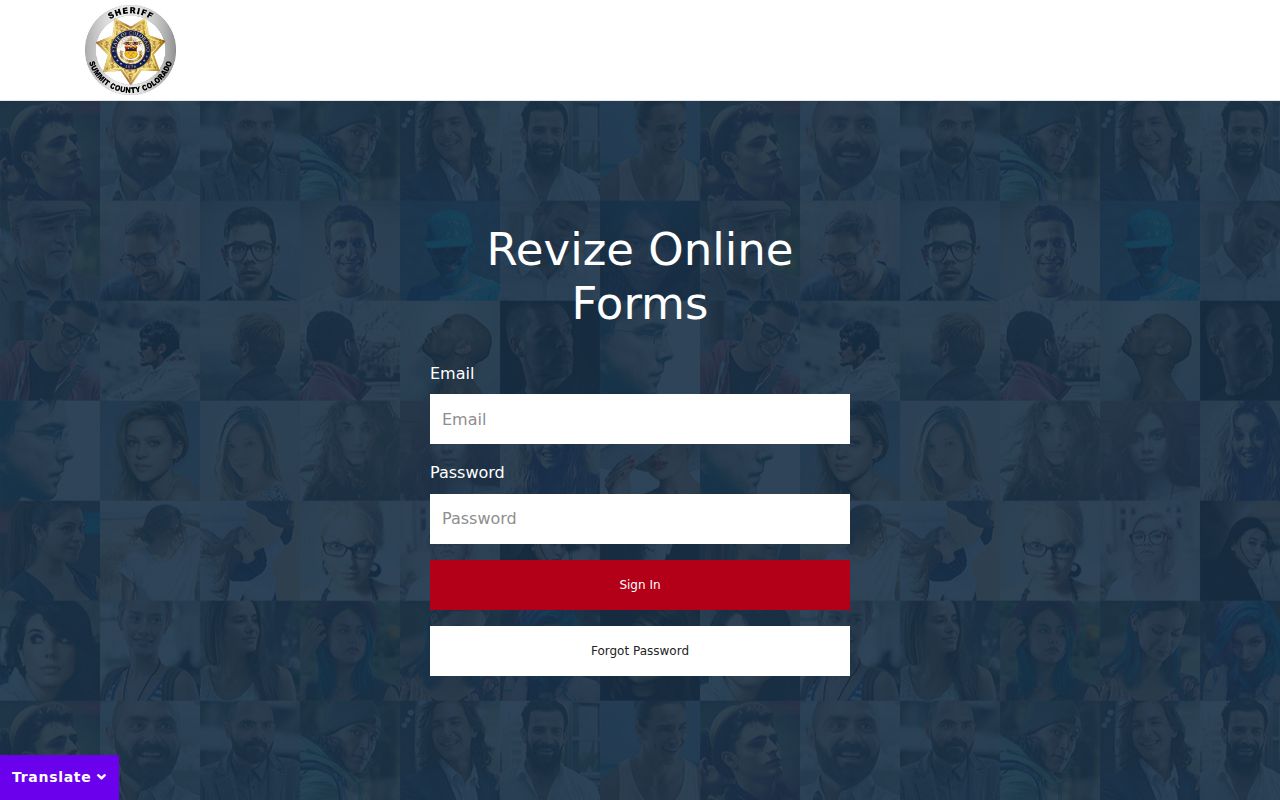
The online form is a request channel, not proof that every arrest report, booking photo, or active investigative record will be released.
Note: Reports are often available within 72 hours, but weekends, holidays, investigations, restrictions, or redactions can extend timing.
Statewide Charge and Arrest History
Statewide criminal history is handled outside the Summit County court clerk and sheriff record systems. The court request form points people seeking statewide criminal history arrest records to CBI Records Check. That path may be useful when the user needs an arrest-history search across Colorado rather than a Summit County report, complaint, disposition, or sentence order. It is still separate from VINE custody notification, DOC offender search, and local jail bonding information.
Municipal charge records can also be separate. Silverthorne/Dillon/Keystone Municipal Court, Frisco Municipal Court, and Breckenridge municipal ticket channels may handle ordinance, animal, municipal traffic, code, harassment, trespass, disorderly conduct, or shoplifting/theft under $1,000 matters within town jurisdiction. When the ticket names a municipal court, start with that town's court or records request process.
Restricted Summit County Charge Records
Juvenile charges, sealed cases, suppressed records, protected victim information, child identifiers, medical or mental health details, protected addresses, SSNs, financial account data, and ongoing investigative material may be withheld or redacted. Colorado Criminal Justice Records Act rules apply to sheriff criminal justice records, while court access to filed criminal cases is governed by court policy such as CJD 05-01 and sealing statutes.
Sealed records are hidden from ordinary public access but may still exist. Expunged records are removed or treated as not existing under specific law. Colorado's sealing framework includes no-charge arrests, non-convictions, eligible convictions, human-trafficking victim cases, pardoned offenses, and conduct that is no longer illegal. Waiting periods and exclusions vary, including restrictions for traffic offenses, DUI, and specified serious cases.
| Sealed | Expunged | |
|---|---|---|
| Public Access | Hidden from ordinary public search. | Removed or treated as not existing when statute permits. |
| Record Exists | Yes, with limited authorized access. | Depends on the specific expungement law. |
| Common Context | Adult arrest and criminal sealing after eligible outcomes. | Juvenile or specific statutory records more often. |
| Search Limit | CoCourts excludes sealed case types. | Ordinary public court search should not be relied on. |
Important: Arrest and charge lookups should not be used for FCRA-regulated employment, tenant, credit, or insurance screening.