
Summit County Probate Division
Probate matters for Summit County are District Court matters at the Summit County Justice Center in Breckenridge. The research did not locate a separate Summit County Probate Court page. Instead, the State Court Structure Map and the court record request form place estate, guardianship, conservatorship, and probate document requests within Summit Combined Courts.
The court form includes Probate as a case type and lists probate document options such as Letters, Will, Trust, Application, Petition, Closing, Claims, and Date of Death. That form is important because a docket listing may show a hearing date, but it does not provide the filed will, letters, or other court documents. The court clerk reviews the request, identifies whether access is allowed, and calculates copy or certification fees.
Probate Division of District Court
Summit Combined Courts
501 N. Park Avenue
P.O. Box 269
Breckenridge, CO 80424
970-453-2272
Records email: 5thJDclerks@judicial.state.co.us
What Summit County Probate Covers
Probate covers the court process used when property, authority, or protection must be handled after a death or for a person who needs court-supervised help. In Summit County, probate records may involve wills, estates, appointment of a personal representative, letters testamentary or administration, guardianship, conservatorship, trusts in some contexts, claims, estate closing, and probate orders.
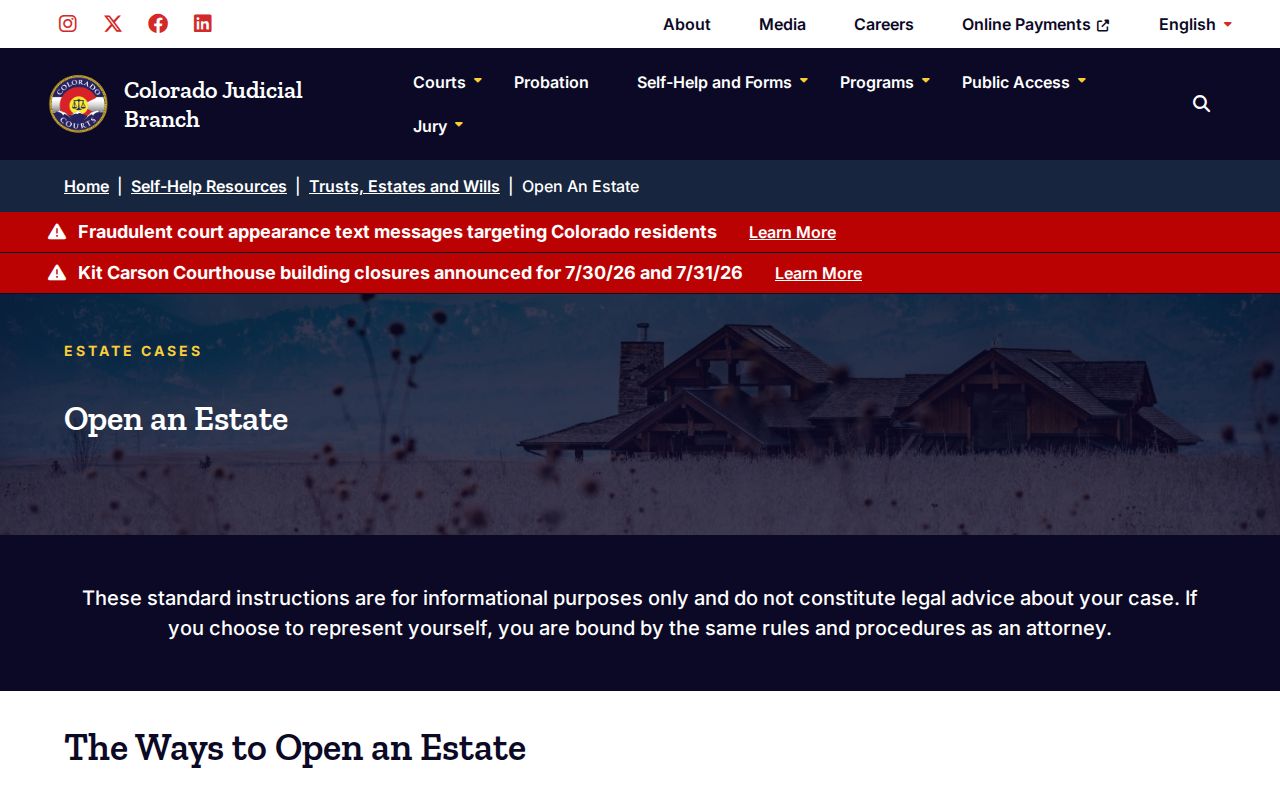
The Colorado Judicial Branch Open an Estate page separates informal and formal probate. Informal probate takes less time and paperwork because the probate registrar reviews the filings and there is no court hearing. Formal probate takes more review because the court gives final approval and interested persons can appear before approval. Formal probate is the safer channel when a dispute may exist or when only a copy of the will exists.
The Open an Estate page is a statewide self-help source, but it maps directly to Summit County because estate filings are filed in the District Court for the proper county. It is also the source for deciding whether the case is an estate opening or a smaller personal-property affidavit issue.
Summit County Probate Terms
Probate records use terms that do not appear in ordinary civil or criminal files. These short definitions are based on the research and Colorado Judicial Branch glossary concepts, and they help identify which document to request from the clerk.
- Testator
- A person who made a will.
- Executor
- A person named in a will to carry out its terms. Colorado materials often use personal representative for the person appointed by the court.
- Intestate
- A death without a valid will controlling the estate.
- Guardianship
- A court case about authority to make personal care decisions for another person.
- Conservatorship
- A court case about authority to manage another person's money or property.
- Letters
- The certified document showing a personal representative's court authority.
Search Summit County Probate Records
The first online channel is the Colorado Judicial Branch docket search, filtered to Summit County and case class PR when a public hearing date is the goal. The docket can help identify a case number, date, location, appearance type, and hearing information. It does not replace a court document request for wills, letters, petitions, claims, closing documents, or a Register of Action.
CoCourts is not the probate answer for Summit County. The research notes that CoCourts excludes probate case types. For copies, use the electronic Record/Document Request Form, the Summit Combined Courts PDF form, in-person service at the court clerk counter, mail, email, or fax where the official court form allows it.
- Search the docket by Summit County and PR case class if a public hearing or case number is needed.
- Use the court record request form when the needed item is a will, letters, trust, application, petition, closing, claim, date of death, or ROA.
- Give party names, case number if known, year filed, case type, and the exact probate document requested.
- Wait for the clerk to review access and calculate fees. The court page says not to send money until asked.
- Provide photo ID if the clerk requires it for probate or protected information.
Note: Probate documents can be public, partly redacted, or restricted depending on the file type and protected information.
Summit County Small Estate Affidavits
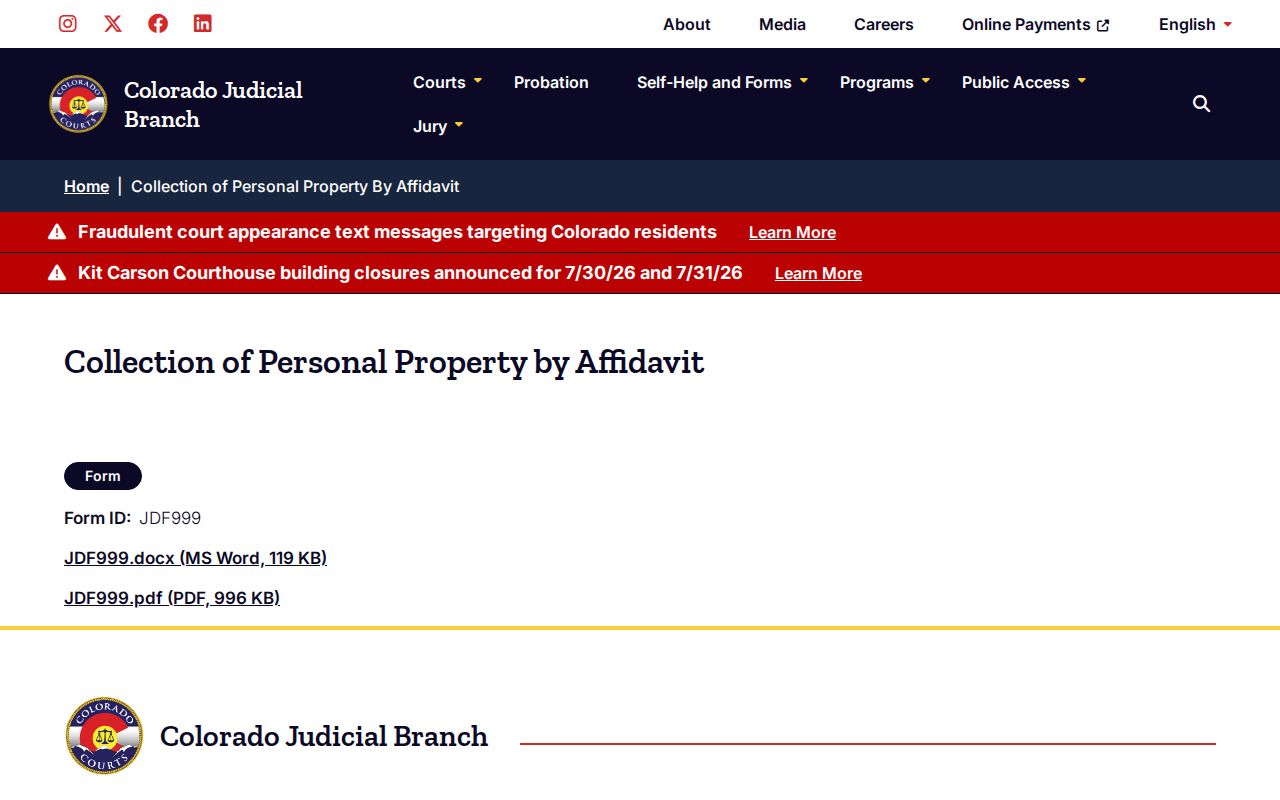
Not every death requires a probate case in Summit County District Court. The Colorado Judicial Branch says heirs may use JDF 999 Affidavit for Collection of Personal Property when the estate value is below the allowed amount and no real estate must be transferred. JDF 998 says at least 10 days must have passed since death, the property value less liens and encumbrances must stay under the year-of-death limit, and no application or petition for appointment of personal representative can be pending or granted.
The research lists the JDF 999 amount as $88,000 for 2026, $86,000 for 2025, $82,000 for 2024, $80,000 for 2023, $74,000 for 2022, and $70,000 for 2021 and 2020. The affidavit is not valid to transfer real estate. When a Summit County decedent owned real estate or a dispute requires a court order, the District Court probate path is usually the relevant route.
The Colorado Judicial Branch small-estate affidavit page is the source for the JDF 999 personal-property option.
Summit County Probate Timing
Colorado timing rules drive when a Summit County estate may be opened. Estate paperwork can be filed 120 hours, or five days, after death. A creditor who wants to open an estate must wait at least 45 days. The proper venue is the District Court in the county where the decedent lived, or if the decedent lived elsewhere but owned Colorado property, a county where the property is located. Denver has its own probate court, but Summit County uses District Court.
After appointment in an informal estate, the personal representative must give interested persons notice of appointment or opened estate within 30 days using JDF 940. Within 90 days after appointment, the personal representative must complete an inventory using JDF 941. The research notes that the inventory is not filed with the court and is not given to interested persons unless they ask.
| Probate Step | Summit County Timing or Rule |
|---|---|
| Open an estate | File no sooner than 120 hours after death. |
| Creditor opens estate | Creditor must wait at least 45 days. |
| Notice after appointment | Give interested persons notice within 30 days in informal estate. |
| Inventory | Complete within 90 days after appointment. |
| Small-estate affidavit | At least 10 days after death and only if statutory conditions are met. |
Summit County Probate Record Fees
The research did not identify a Summit-specific probate filing fee schedule, so the fee table below is limited to court copy and search fees documented in the court record request sources. Filing fees should be checked with the court clerk or Colorado Judicial Branch forms before submitting a new estate case.
| Item | Amount or Note |
|---|---|
| Electronic copy | $0.25 per page. |
| Photographic copy of document on file | $0.75 per page on the PDF form. |
| Certified or exemplified copy | $20 per document. |
| Name search or non-party search including ROA | $5. |
| Off-site retrieval | Actual cost on electronic form or $5 on the Summit PDF form. |
| Research or redaction | $30 per hour, assessed in 15-minute increments after the first hour. |
Restricted Summit County Probate Records
Probate records are not all open in the same way. The court request form warns that juvenile and probate records, or documents with confidential and protected information, may require U.S. government-issued photo ID. Guardianship, conservatorship, medical, minor, protected-address, financial account, and redacted personal-identifier details may be withheld or reviewed before release.
Use a precise request. Ask for the will, letters, trust, application, petition, closing, claims, date of death, or ROA rather than asking broadly for "all probate records." That helps the Summit Combined Courts clerk identify the file, apply access rules, and calculate the right copy or certification cost.
Probate is related to family status records, but it is not the same as Summit County marriage and divorce records. Marriage certificates come from the Clerk & Recorder, divorce decrees come from District Court domestic-relations files, and probate files come from District Court probate matters.